
It's Not That Your Team Won't Speak Up. Your Records Aren't Flowing.
If judgment disappears every time a project ends, the next person and the next AI always have to learn from scratch. This piece explains how to build an operating flow by recording retrospectives, decisions, and next actions.

Sometimes it feels like your team doesn't report. You only learn what's in progress by asking, and context surfaces only after a problem has occurred. Naturally, the leader starts thinking, “Should I hire someone to organize things in the middle?”
That doesn't mean the thought is wrong. But before adding people, there is one thing to check: where judgment is kept in this organization after a project ends.
A misdiagnosis loop that looks like a people problem
If which options were dropped in a meeting, why the schedule changed, and which mistakes should not be repeated next time all end up only in the leader's memory, a newly hired manager will start the same learning all over again. Team members find it hard to know whom to tell and in what format, and the leader keeps wondering why nothing comes up.
- Progress isn't visible in time.
- The leader first suspects people's attitude or ability.
- A new manager or a new tool is brought in.
- Previous decisions and criteria are still not recorded.
- The new person also relearns everything by asking the leader.
The problem here is not silence itself. It is that there is only one channel through which conversation turns into judgment and becomes a record the next person can reuse.
Three kinds of records you need before AI
1. A retrospective is not paperwork but time to leave input
If you ask a busy team to write long retrospective documents from scratch, the practice quickly disappears. A more realistic approach is to record three things, however briefly, after a project ends.
- What changed this time?
- Why did we make that choice?
- What will we check first next time?
AI can help turn spoken retrospectives into text. But if the original judgment was never kept, AI has nothing to work with.
2. Keep decision criteria alongside the deliverables
If you only archive finished documents or screens, the next person sees the result and has to guess the context. Next to what you built, note what you decided not to build and what conditions would change that decision, and the record becomes a manual for the next person.
3. Write the owner and check date of the next action in one line
Records that simply pile up in an archive never get read again. If the last line states the next action, the owner, and when it will be checked, reporting shifts from something that depends only on people to an operating flow.
The moment retrospectives connect to AI
AI does not fill in an organization's missing context on its own. Conversely, once retrospectives and decisions accumulate, you can ask it to look up how you decided on a similar matter last time and summarize only what differs under current conditions.
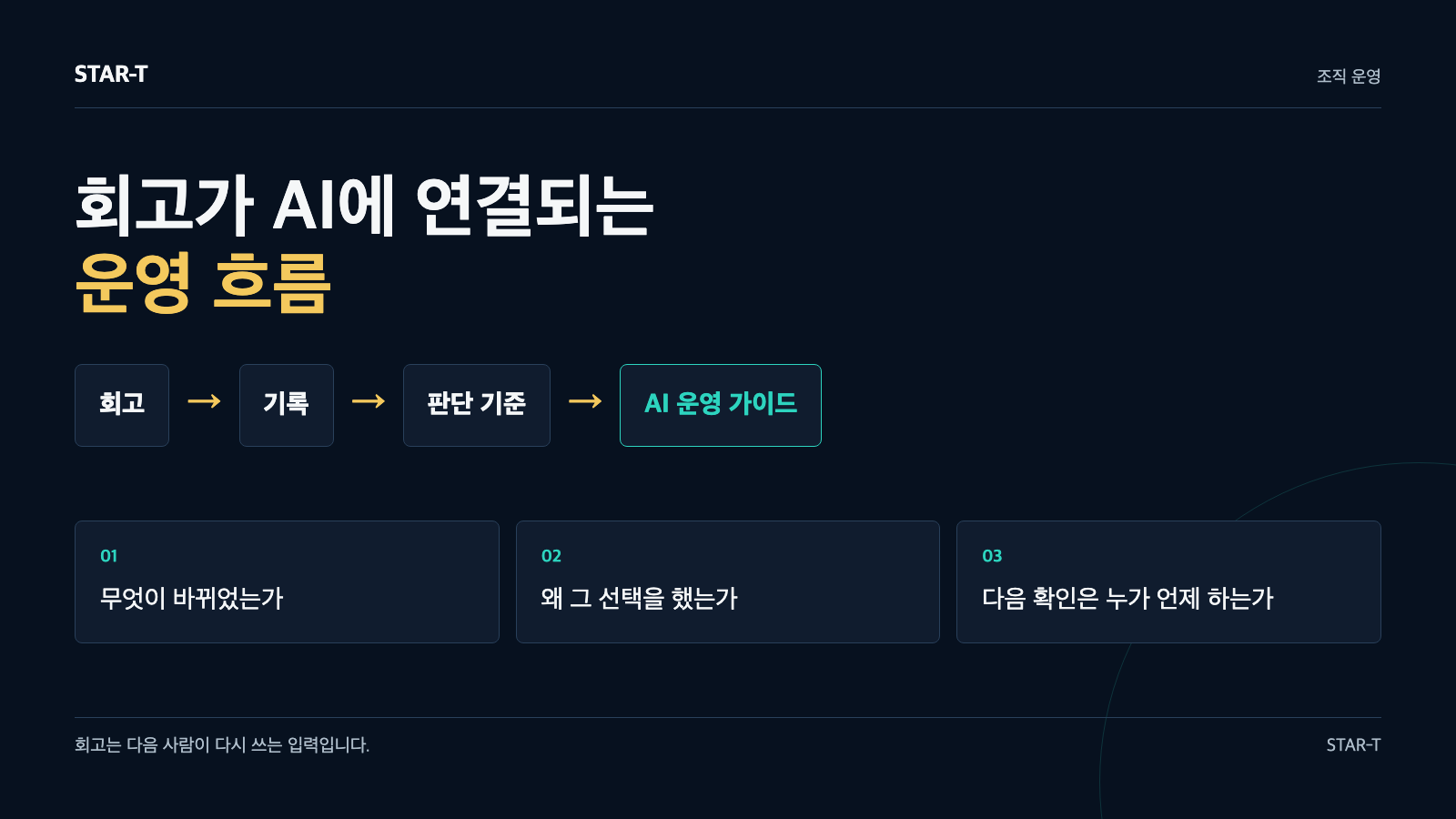
At that point, AI shifts from a tool that produces generic answers to a tool that brings back the criteria your organization has kept. Organizations preparing to adopt AI can start by designing an approach that reviews current work and record flows together.
Today's action: leave just three lines from one project
The first step of AI adoption doesn't have to be buying a tool. Pick one project that ended this week and first check whether the next person could find the judgment made at the time.
- Can you find the retrospective from your last project right now?
- Is it recorded what you gave up at the time and why?
- Are the owner and check date of the next action written down?
- Do the team decision criteria you'd want AI to reference actually exist?
Writing long retrospectives is not the goal. The goal is to make them something the next person can find again and reuse in the next project.
Engagement
Views and reactions are saved as internal content signals.
Key points
- •Reporting bottlenecks may come less from individual silence than from a record structure where judgment stays with only one person.
- •Simply recording, for each project, what changed, why a choice was made, and who checks next and when is enough to become input for operations.
- •As records accumulate, AI can go beyond being a general-purpose answer tool and help find and compare the team's past decisions.
Frequently asked questions
Do retrospectives have to be long?
No. Start with the minimum input the next person will reuse: what changed, why you decided the way you did, and who checks next and when.
Can AI understand the team's context without retrospectives?
AI cannot reliably reconstruct decisions and context that were never recorded. When retrospectives and criteria are kept, it can be used to find and compare past decisions.
Where should records be kept?
More important than the tool is agreeing on one place the team will actually search and update in the next project. It works well to link decision criteria, options you set aside, and next actions together with the deliverables.
Don't just read — connect to the right service or consultation and take action now.
Once you understand the problem through insights, the next step is deciding on the execution structure. Jump straight to related services or a free consultation.
Free Meeting / ConsultationSTAR-T
STAR-T Chief Consultant
As an IT service planning and design expert, I research and share success stories from various startups and companies.
Take Action
Don't just read — connect to the right service or consultation and take action now.
Once you understand the problem through insights, the next step is deciding on the execution structure. Jump straight to related services or a free consultation.