
The Real Reason a Market Leader Disappeared in Six Years — Dissecting Nokia
In 2007, Nokia was the dominant market leader, selling roughly 40% of the world's mobile phones.[^1] That same year, the iPhone came out. Six years later, Nokia sold off its entire phone business.[^2] The usual conclusion is "it couldn't keep up with innovation." But that is only half right.
The Real Reason a Market Leader Disappeared in Six Years — Dissecting Nokia
In 2007, Nokia was the dominant market leader, selling roughly 40% of the world's mobile phones.[^1] That same year, the iPhone came out. Six years later, Nokia sold off its entire phone business.[^2] The usual conclusion is "it couldn't keep up with innovation." But that is only half right.
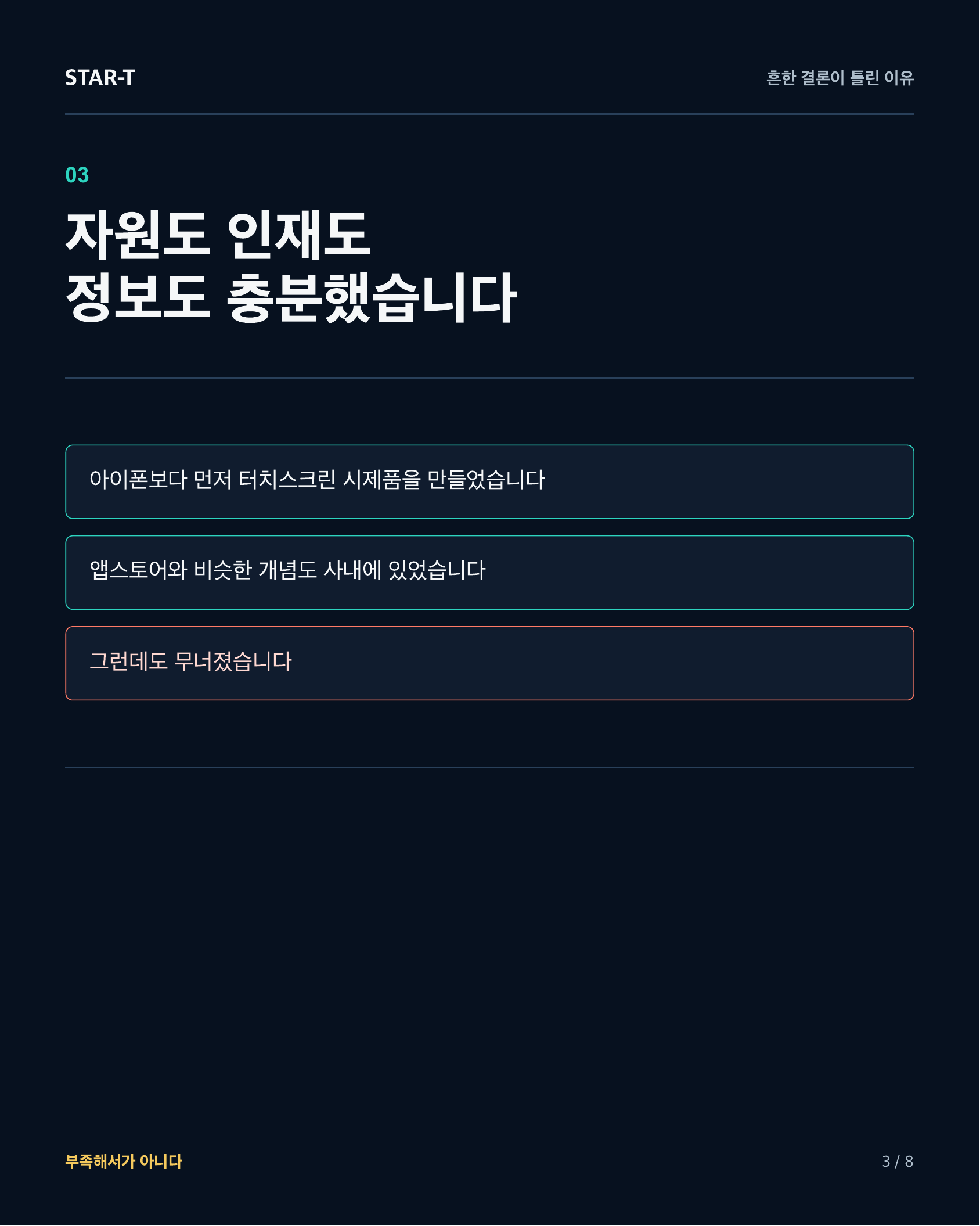
Nokia did not lose for lack of technology. It built a touchscreen prototype before the iPhone, and it had a concept similar to an app store inside the company. It had enough resources, talent, and information.
And yet it collapsed. That is exactly why this case should worry solo founders. It is a case of losing not because it had too little, but because it had too much. Let's dissect it through four lenses.
Turning point 1. "Existing assets tied its decisions down"
In 2007, Nokia had two core assets: the Symbian operating system and the world's largest hardware production scale.
Both became shackles at the same time.
- Symbian was already installed on hundreds of millions of devices. Switching to a new OS meant abandoning that asset.
- The production lines were optimized for the existing way of working. Shifting to a software-centric model would erase the advantage of that scale.
So Nokia kept making decisions to 'protect what it had.' It looked rational. It had a lot to protect, after all. But while the market's definition shifted from 'hardware' to 'software ecosystem,' Nokia kept optimizing on top of the old definition.
This is the same pattern we saw with Kodak in Part 1. The biggest asset becomes the biggest shackle.
Turning point 2. "The organization could not pass bad news upward"
A deeper cause that later research uncovered was organizational culture. According to a study by Vuori and Huy of INSEAD published in Administrative Science Quarterly (2016)[^4], middle managers knew that "Symbian is losing its competitiveness," but could not report it upward. The atmosphere was such that delivering bad news to temperamental executives meant taking the blame yourself. The researchers identified this 'shared fear' spread across the organization as a key driver of the collapse.
Executives received only "everything is fine" reports. The information existed inside the organization, but it never reached the decision-makers.
For solo founders, this is just as dangerous, in a different form. We have no middle managers. Instead, we ignore bad news ourselves. We do not report the signal "this direction seems wrong" to ourselves, because we regret the time and money we have already put in.
A question for your business: In your business right now, what 'bad signal' are you knowingly ignoring?
Turning point 3. "The bigger the sunk cost, the harder it is to let go"
Nokia could not let go not because it was irrational, but because it had invested too much. Billions of dollars poured into Symbian, and tens of thousands of jobs tied to it. The decision to abandon it carried a matching amount of pain.
Economics calls this the sunk cost fallacy. Money already spent should not factor into future decisions, but humans instinctively factor it in. The more you spend, the harder it is to let go.
This is where the real strength of a solo founder comes in. Our sunk costs are small. For Nokia, changing direction involved billions of dollars and tens of thousands of people; for us, it takes a few months of time and a little pride.
The good news: Having little means you can change direction faster and more cheaply.
Take Action
Free Meeting / Consultation
Clarify your next action and scope based on the context you just read.
Turning point 4. "Who could have changed the definition?"
Microsoft's Nadella, whom we saw in Part 1, revived the company by redefining a 'Windows company' as a 'cloud company.' Nokia did not have someone to make that decision in time.
The difference was not authority but timing and courage. A decision to change the definition always has to be made amid the question "things are still fine now, so why?" Once you have collapsed, it is already too late. Nokia should have changed while it was number one.
A question for your business: While things are going well now, can you sketch your next definition in advance? When a crisis hits, you will have no options left.
Four sentences Nokia left for solo founders
- Your biggest asset can become your biggest shackle — regularly ask, "What if I had to abandon this?"
- Do not ignore bad signals — a solo founder has no boss to report to, so you are your own auditor.
- Small sunk costs are an opportunity — now, while you have little, is the best time to change direction.
- Change your definition in advance while things are going well — changing it in a crisis is too late.
Nokia left us a lesson worth tens of billions of dollars, for free. Whether we end it with "what a remarkable case" or use it as a mirror for our own business decisions is up to us.
If you do just one thing today
Write down **"one bad signal you are knowingly ignoring"** in your business right now. That is the very signal Nokia's middle managers never managed to pass upward.
If it is hard to write it down alone, let's start by bringing that signal out together.
Request a free consultation → One hour to face, together, the one signal you have been ignoring.
Sources (fact-checked: deep-research 2026-06-01)
[^1]: About 40% share of the overall mobile phone market in 2007 — Gartner (compiled by Statista). https://www.statista.com/statistics/271574/global-market-share-held-by-mobile-phone-manufacturers-since-2009/ [^2]: Nokia's Devices & Services business sold to Microsoft for USD 7.2 billion (EUR 5.44 billion), announced 2013-09-03 — Microsoft newsroom + Nokia SEC Form 6-K (primary). https://news.microsoft.com/source/2013/09/03/ · https://www.sec.gov/Archives/edgar/data/0000924613/000119312513371164/d600359dex991.htm [^3]: Nokia smartphone share 48.7% (2007 Q3) → 3.1% (2013 Q2) — Statista/IDC. https://www.statista.com/statistics/263438/market-share-held-by-nokia-smartphones-since-2007/ [^4]: Vuori & Huy (2016), "Distributed Attention and Shared Emotions: How Nokia Lost the Smartphone Battle," Administrative Science Quarterly. https://journals.sagepub.com/doi/10.1177/0001839215606951 · Supplementary: INSEAD Doz & Wilson, Nokia: The Inside Story / HBS Case "The Rise and Fall of Nokia."
This series (a trilogy) is STAR-T's translation of big-company strategy into the decision-making language of solo founders. The figures and citations in the Nokia installment were verified against primary and academic sources (basis: _근거_노키아_검증.md).
If you are wondering whether your organization shows the same signals,
a 2-minute diagnostic can help you see where to add structure first. Please answer only as much as you are comfortable with.
Engagement
Views and reactions are saved as internal content signals.
Key points
- •Nokia did not lose for lack of technology: it built a touchscreen prototype before the iPhone and had enough resources, talent, and information, yet it collapsed — a case of losing because it had too much.
- •Its two core assets, the Symbian operating system and the world's largest hardware production scale, became shackles at the same time and led it to keep making decisions to 'protect what it had.'
- •A 2016 study by Vuori and Huy published in Administrative Science Quarterly identified the 'shared fear' spread across the organization, which kept middle managers from passing bad news upward, as a key driver of the collapse.
- •The bigger the sunk cost, the harder it is to let go; for solo founders, small sunk costs become a strength that lets them change direction faster and more cheaply.
- •A decision to change the definition must be made while things are going well, not after a collapse, and Nokia did not have someone to make that decision in time.
Frequently asked questions
Why did Nokia fall?
The core issue was not a lack of technology but that its existing assets tied its decisions down. While it kept choosing to protect Symbian and its large-scale production facilities, the market's definition shifted from hardware to software ecosystems. On top of that came an organizational culture in which bad news did not reach the executives.
How much did organizational culture contribute to the collapse?
According to Vuori and Huy's 2016 study in Administrative Science Quarterly, middle managers knew Symbian was losing its competitiveness but did not report it, because the atmosphere meant that delivering bad news would get them blamed. The researchers saw this 'shared fear' as a key driver of the collapse.
What lessons does this case offer solo founders?
The article sums it up in four sentences: your biggest asset can become a shackle, so regularly ask 'what if I had to abandon this?'; audit bad signals yourself; now, while sunk costs are small, is the best time to change direction; and change your definition in advance while things are going well.
Don't just read — connect to the right service or consultation and take action now.
Once you understand the problem through insights, the next step is deciding on the execution structure. Jump straight to related services or a free consultation.
Free Meeting / ConsultationSTAR-T
STAR-T Chief Consultant
As an IT service planning and design expert, I research and share success stories from various startups and companies.
Take Action
Don't just read — connect to the right service or consultation and take action now.
Once you understand the problem through insights, the next step is deciding on the execution structure. Jump straight to related services or a free consultation.